Nintendo console · Generation 4
Super Nintendo
Super Nintendo (1990), the Super Famicom in Japan: 16-bit console with Mode 7, a Sony-designed sound chip and enhancement chips in its cartridges.
History of the Super Nintendo
With the PC Engine and Mega Drive, two 16-bit consoles that outclassed the Famicom, on the market, Hiroshi Yamauchi revealed in September 1987 that Nintendo was working on the Super Famicom. It was designed by Masayuki Uemura, creator of the Famicom. Ricoh supplied the CPU, derived from a Western Design Center chip, and Sony's Ken Kutaragi designed the sound chip. A lack of software for outside studios and a global chip shortage pushed the launch back to autumn 1990.
The Super Famicom launched in Japan on November 21, 1990, at ¥25,000, with Super Mario World and F-Zero. The first shipment sold out within hours, and consoles were delivered at night to avoid theft. It reached North America on August 23, 1991, as the Super Nintendo Entertainment System, with its own case design and a US$199 price, and the UK and Ireland in April 1992. Nintendo kept key publishers such as Capcom, Konami, Square and Enix.
Its main rival was the Genesis, in a console war shaped by Sega's aggressive advertising. Nintendo secured the first home conversion of Street Fighter II and relaxed its licensing rules; its version of Mortal Kombat, however, was censored. It received over 1,700 games, such as The Legend of Zelda: A Link to the Past, Super Metroid and Final Fantasy VI, and Donkey Kong Country kept it relevant in 1994 against 32-bit consoles. Its cartridges could carry enhancement chips such as the Super FX.
The Nintendo 64 succeeded it in 1996. In 1997 a smaller, cheaper model arrived in North America, followed in 1998 by its Japanese counterpart, the Super Famicom Jr. Production ended in North America in 1999 and in Japan on September 25, 2003. It was the best-selling home console of its generation and is now ranked among the greatest ever. Its games have returned via Virtual Console, Nintendo Classics and the SNES Classic Edition.
Milestones
1987
September 9: Hiroshi Yamauchi reveals the Super Famicom is in development.
1990
November 21: Japanese launch with Super Mario World and F-Zero.
1991
August 23: arrives in North America as the Super NES.
1992
April: launch in the UK and Ireland; the rest of Europe follows that year.
1994
November: Rare releases Donkey Kong Country.
1997
October: the redesigned SNS-101 model is released in North America.
1998
March 27: the Super Famicom Jr. is released in Japan.
1999
Production ends in North America.
2003
September 25: Nintendo stops making the Super Famicom in Japan.
Models and revisions
The hardware variants of the Super Nintendo and their model numbers.
Super Famicom · 1990
Japanese model with a rounded design, darker grey buttons, the four-colour logo and NTSC-J output.
Models: SHVC-001
Super NES (Norteamérica) · 1991
Lance Barr's own boxy design with purple switches; its curved cartridge bay stops food or drinks being placed on top.
Models: SNS-001
Super Nintendo (PAL) · 1992
European and Australian version using the Super Famicom design, with PAL output and many country variants.
Models: SNSP-001A
Model historyHyundai Super Comboy · 1992
South Korean version distributed by Hyundai Electronics, with the Super Famicom case, NTSC output and the American power connector.
Models: SNSN-001, HGM-3000
Super Nintendo Playtronic (Brasil)
PAL-M model with the North American design, built in Manaus by Playtronic; it was the only SNES produced outside Japan.
Models: SNSM-001
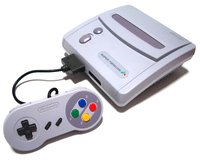
New-Style Super NES / Super Famicom Jr. · 1997
Smaller, cost-reduced model from 1997 in the Americas and 1998 in Japan, with the hardware on a single chip. It never reached Europe.
Models: SNS-101, SHVC-101
Model historyNintendo Super System
Arcade unit for previewing 11 SNES games in US stores, with slightly modified hardware and a 25-inch monitor. Production ended in 1992.
Special editions
Limited editions, colours and commemorative bundles.
- 1991
Pack Super Mario World · Norteamérica
North American launch bundle with Super Mario World included.
- 1997
Pack New-Style Super NES con Yoshi's Island · Norteamérica
Redesigned model bundle with Super Mario World 2: Yoshi's Island, at US$99.95.